In Tune: Writing about Music in Fiction! 🎶

I’m crafting some exciting new projects for 2024, including a delightful 4-week online writing class at WOW! for February.

Introducing: IN TUNE: Writing About Music in Fiction!

If you’re looking to treat yourself to some writing motivation or looking for the perfect holiday or birthday gift for the writer in your life, look no further! This class will rock! 🤩🎸🥁

Course description:

Fiction is filled with references to music: from high-school dances and music-school students, singers, music teachers and lessons, garage bands and musical instruments to records, rock concerts and folk/indie festivals and coffee-house performances, opera and musical-theatre performances, and so much more. Many of us spend our happiest hours with music in the forefront or background of our lives as soundtrack. There’s a type of music-inspired prose for as many musical genres as you enjoy.

Whether you’re writing a scene or story about a music practice, a novel with a musician or music fan as a protagonist, or just want to know more about how musical fiction works and/or add musical references, vivid characterizations of vocal performance, or music-centered scenes or references to your writing, this course will explore how music culture, sound, setting, POV, and more are portrayed within fiction to enhance and inspire your own rhythmic, compelling prose. Knowing how to read musical notes isn’t required for this class—just the desire and sincere appreciation for both music and literature and to add another tool to your literary toolkit.

Students will choose one novel with a musical plot to read independently, and the instructor will provide excerpts from music novels as well as handouts and a weekly writing assignment to get the muse melodically flowing! Join us for this new course that’s sure to strike a chord.”

To the great joy of writing and music! Sign-ups open now! Clickety-click: IN TUNE: Writing About Music in Fiction!

Give Yourself a Break 🍂

Here's the nudge you've been waiting on. Go ahead. Give yourself a little break today.

My daily and weekly to-do lists run off the page; I'm sure most of yours do, too. I so seldom decide to clear some time in my afternoon for a slowdown, but I knew when I woke this morning that it was just what I needed to rejuvenate my artistic well.

For an hour or two, I'll continue to play with my photos and maybe start some poetry or prose, too. And perhaps read or listen to music.

Even if you can only squeeze in twenty minutes and you schedule it in for tomorrow or a weekday or an evening after work or at 4 am before work, give yourself the gift of a pause to daydream, create, nap, listen to music, reflect, take a walk, take up space.

You, too, deserve an unexpected respite. 🥳
#artistslife #artistslifeforme #createeveryday #rejuvenate

🍂Enter the Thankful for Books Giveaway 🍂

Super excited to participate in Women on Writing’s Thankful for Books Giveaway, starting today and running up to November 20th! 🍂📚

Copies of my book, From Promising to Published , will be part of the prize packages for three lucky winners.

Read more and enter the contest at: Thankful for Books Giveaway!

Good luck, and happy reading! 🍁📔

My Photography Chosen for J. Mane Gallery's Juried Exhibition: "Eat" 📸

I’m so pleased that 5 of my photos were chosen as part of J. Mane Gallery’s latest juried exhibition. The theme is “Eat.” Among them are these 2 photos that were so fun to take and make. 📸😊

See my other 3 photos and all of the amazing art by talented artists at: J. Mane Gallery “Eat” Exhibition.

If you’re in the market for an awesome online writing class, check out my similarly themed Food Writing for Fun and Profit (starting Friday, October 6th).

To art and food!

"Four Reasons Food Can Spice Any Genres You Write" 🍝

Wonderful news! 🥳My article was published by Women on Writing today! Check it out, and then give the writing prompt a whirl. 📝


Four Reasons Food Can Spice Any Genres You Write

By: Melanie Faith


Photo by Mae Mu on Unsplash.

It’s just about autumn in the US, which is an important weather shift in the seasonal states. Humidity dissolves as leaves turn into a crayon-box bonanza of shades while it remains sunny, bright, and crisp enough for a walk in a cozy, knit sweater and a mug of steamy tea after.  Another signal of the time shift is the shortening of days and the lengthening of my appetite.


While I enjoy eating all year ‘round, there’s something special about the chill in the air and the darkening of the evenings that increases my appreciation for sweet and savory flavors. Bring on the ooey-gooey cakes and breads, the creamy mac and cheese, the hearty, saucy spaghetti Bolognese!


No matter the season, the rituals of eating; snacking; food buying, storage, and preparation; meal clean-up; and food sharing surround our days and can be integrated into our writing to enrich our work.  Let’s look at four reasons why adding food writing to our repertoire can deepen our writing:


Food connects us: Nothing reminds us more of our communities and the cultures we belong to than food.  References to the recipes, meals, and snacks your protagonist grew up eating and still makes can provide shorthand for so many parts of your character’s background and life, including but not limited to her family of origin’s geography, socioeconomic status, and more. Certain foods will instantly be connected in readers’ minds with a particular state, region, cultural heritage, or country, while other foods and beverages are universal to many communities—which will give your readers other insights into how your unique character fits into a larger trend or social sphere or, conversely, how they might rebel against it.  Including meals or restaurant scenes can also demonstrate how your character interacts with others, what she feels comfortable saying or not saying, what she wants to share in public compared to her private thoughts, and so much more.


Speaking of which, food can create both bonds and tensions:  If one of your characters loves attending a weekly potluck she organizes and hosts once a month while another character lives for a quiet dinner for one at home to get away from the stresses of his day job and rejuvenates with the radio on while preparing couscous and a salad, you’ve already set up a way to show (rather than tell) extroversion and introversion. You’ve also set up a scenario where their differing styles could create conflict if these characters become friends, coworkers, family, or romantic partners. Characters can react strongly, or they might have inner hopes or misgivings about what is being served, about their dining companions, or about where the dining takes place. 


Food is also often connected with larger social issues that deeply impact many people both locally and globally—such as food instability, hunger, and ever-rising grocery prices—that you can shine a light on within your writing in nonfiction, poetry, flash, novels, and many other genres.

Photo by Atie Nabat on Unsplash


Favorites and aversions make us each unique. Including small details about what your character loves and loathes eating can strengthen your characterizations. Just like all of us, characters can have detested foods show up in their lives and have to navigate their distaste quietly or verbally, or they can absolutely love quirky regional favorites that their friends and family can’t stand or refuse to try. Conversely, we all love to share our favorites, and sometimes these favorite foods are eagerly adopted by those we love, spreading the joy. Writing that praises, describes, humorously disses, or delights in foods can connect with your audience’s own experiences of likes and dislikes.


Try this exercise!  If you write fiction: your antagonist has just invited your protagonist to dinner. Where will they go? What will they talk about? What is being served for dinner? If you write nonfiction, poetry, or other genres: jot a list of five of your favorite or least favorite foods. Pick one of the foods, set a timer for twenty minutes, and describe a time when you were served or served others this particular food. Use as many sensory details as possible to denote the food and reactions to it. Go!


 Care to learn more? I have a few spots left in my Food Writing class that begins Friday, October 6, and I’d love to have you and a friend join in the fun. Details at: Food Writing for Fun and Profit.


Strawberry Doodle and Poem

Trying something new today--a poem I wrote to coordinate with this doodle I made and then colored in this week. 🎉

“Strawberry”


Remember

how Grandma’s lawn

although about an acre

expanded, endless

in bare feet, the orange

tiger lilies that grew almost

as tall as you

wild in a tangle

of July sun

in the far corner

of the garden?


You can return

anytime you like

in your mind’s eye,

even more than

twenty years after

the land, the house

was sold

when you were already

an adult


you keep this

summer, this sweet

strawberry taste on your tongue

as if seven again. Recall

all the days and days

awaiting then

into a new millennium, faraway

feeling as the spangled cosmos.

"Abounding Images: An invitation to Imagery Power: Photography for Writers" 🎉📸

So pleased that my article was published today as a Women on Writing Spotlight article. Check out the prompt I share as well:

“Abounding Images: An Invitation to Imagery Power: Photography for Writers”

By Melanie Faith


                I found three rolls of brand-new film in a drawer earlier this week that I’d forgotten I’d purchased. It felt a little bit like unwrapping a Christmas gift to myself. Eager to head into the great weather, I took my ‘90s Canon Rebel outside for a few nature shots. The heft of the camera body nestled in my hands just right. Working with a physical, clicky dial to blur the background and focus on the foreground was like stepping back into a favorite pair of blue jeans—comforting and the perfect fit. Need I say that I took the rest of the roll and returned to my desk, smiling?

                I’ve also been taking a lot of photos with my cellphone camera and find it a wonderful photographic experience, too. It is featherweight, and I can take as many pictures as I please. Cellphone cameras have come a very long way in the past ten years. Smart phones are equipped today with much better software and make sharper photographs than any of my first digital cameras. And they’re quite easy to use, and super handy. Rare is the person without a phone as a near-constant companion, which (of course) makes them absolutely the best for capturing inconspicuously as we go about our daily lives. And sharing cellphone photos is so easy it’s a dream.

                Whether you prefer making photos with an old-school film camera that takes film or film cartridges, taking pictures with your cellphone, or a combination of both, there’s something meaningful and meditative about the art of photography. Much like the craft of writing, we begin to see our surroundings, our daily lives, and even ourselves a bit differently, a bit better in some ways, by taking the time to focus on elements we might previously zip past on our way to the rest of our appointments and to-do lists. The fact that no two people see the same images in the same way nor interpret them in the same way enhances our development as artists.

                Making a photograph, like making a poem or a short story or a song or a chapter in a novel or an essay, is deeply personal. We have so many options that it’s exhilarating. We get to choose the subject. We get to choose the angle we take the image from. We get to choose the crop or zoom of the photo. We get to choose if we print the photo to make it a physical object in the world or if we keep it a digital file. We get to choose if we make the photo part of a series on a subject or if the photo is a one-off and stands alone. We get to choose light source and time of day and if we scan or upload the photo to software to alter its hues (hello, black and white!) or shoot in black and white mode or with b & w film.  

                It is in making these choices, often intuitively and in quick succession and very frequently learning and experimenting as we go, that we grow in other art forms as well.

Thinking about making a better photograph certainly continues to influence and encourage my poetry as well as my prose. Photography, much like writing and other art forms, focuses on the importance of the image, the resonance of created expression, and the great fun and challenge when we take the world as we experience it and offer a new creation that very likely will connect with other people who themselves make writing and other art.

                There’s no prerequisite needed, and I’ve had students who made visceral, beautiful, jaw-dropping photos from disposable cameras, phone cameras, underwater cameras, instant cameras, pinhole cameras, film cameras of many makes, and even from photosensitive photographic paper.

The field of photography is wide open to individual interpretation and vision. Begin where you are, with that little “Hmmm, that’s interesting” when you’re out on a morning walk, and see where it takes you. One snap, one click, one moment documented at a time.


Try this prompt: Make a photo today of an object someone else uses every day. Aim to show a special quality about this object—whether its shape, its size, its hue, its placement in the home or outside, or some other quality. After taking the photo, either write a few sentences describing this object, why you chose it, and who uses it OR create a character who uses this object and write about that character for fifteen or twenty minutes. What would happen if the character reached for the object and it was missing? Go!

  ***


My New Online Poetry Class 🎊

In the market for an online poetry class sure to get your pen moving? I’ve got you.

Sign-ups open for my Jump-Start Your Poetry Practice class that begins Friday, April 21st. I’d love to work with you and a friend. 😊👍

More info at: Jump-Start Your Poetry Practice class.

Poetry Publication in Songs of Eretz! ✍️

I’m so pleased to announce that a poem I wrote about roller skating was published today in Songs of Eretz Poetry Review’s Spring 2023 issue! The theme is “Growth.” It’s also a great joy to appear in the same issue as my dear friend, Charles. Follow the linky-link to check out the issue, filled with poetry and photography by many talented artists.

A splendid way to start National Poetry Month! To all of the poems we’ll read, write, and celebrate this April!

New Notebook, New Season, New Doodle📝

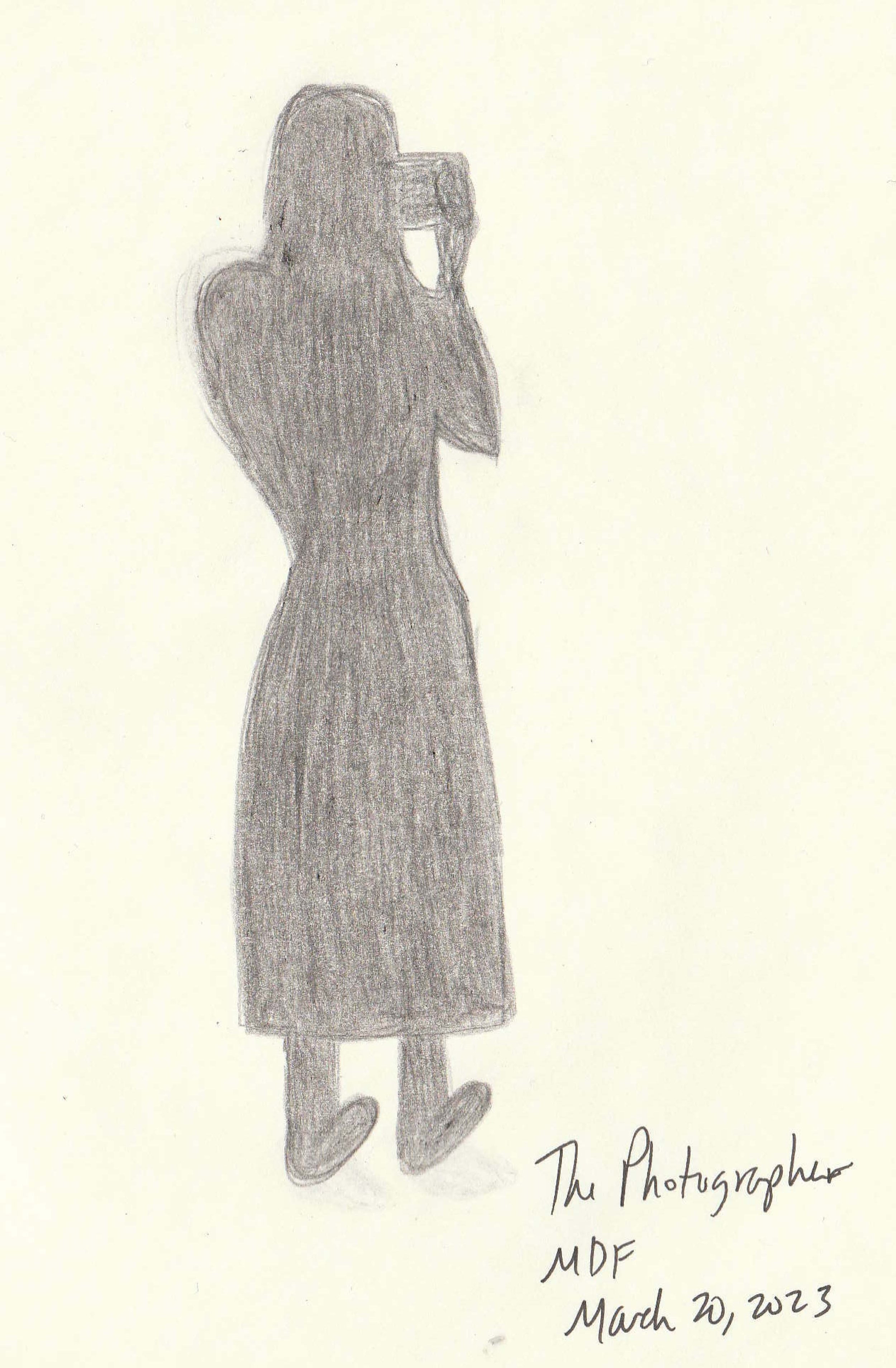
Starting a new notebook—this little 5 x 7 beauty was a whole $1.25—is always a good feeling for me. Potentiality on each page. I’ve been experimenting with different types and sizes of paper for my doodles.

Last night, right before sleep, I broke out my new notebook, my 0.7 mm lead pencil, and my colored pencils and made an outlined sketch of a photographer. It was a peaceful, simmering hour as I drew a preliminary/reference sketch on scrap paper, opened the second page of the notebook (I often skip the first, as it sits a bit askew in the binding), and then started this drawing.

Filling in the figure was a particularly pleasant part of the process as well—colored pencils force a kind of quiet contemplation and over-and-over-and-over patience that slows my thinking and flashes me back to childhood hours quietly coloring or writing.

It’s probably not surprising that I would choose to draw a photographer in motion. One of my other happy places is photography (a few years ago, I wrote a book that combined my writing with my photography practice and tips, Photography for Writers).

Much like when writing, when I’m behind the lens, the daily drops away. I like the challenge of making what I see and how I see it into a composition. I like that it’s not an easy process nor a process I can take for granted or even a process that I fully steer, but that there are many do-overs available—as many as I have time and inclination to make.

Mostly, photography is a place of rare transcendence where the world slows and I make my thinking and my seeing into something at once me and not me. It’s a good space.

This is my first go-’round with sketching what I’m calling a silhouette portrait. Kindly ignore the erased shoulder and erased original feet, which I only realized after pondering them were pointing in the wrong direction from her body’s stance along with the smudge at the bottom of the page by the date. We’ll just call those markers of authenticity.😁

I have to say, though: I was a little surprised that one or two elements of this drawing felt to me like what it feels when I’m behind my camera: a liminal in-between space that just is what it is and unfolds as it should (if, frequently, not as I would have originally imagined).

Or maybe this is just my fancy-pants way of saying I couldn’t believe it actually sort of resembles a human and not a stick figure. 😆

The little notebook says “Plan” on the cover, but as we know, there are many things we simply cannot plan. Mostly, we can move, slowly, in a slightly new direction and see what happens, and then repeat the process as the happening unfolds. Drawings, photographs, writing, ourselves—all unfolding.