"4 Ways Doodling Enriches the Writing Process"

Great news! My article with tips for doodling and writing was published today at Women on Writing! Read on for some tips and info about my online drawing class that begins Monday, August 3rd.

“4 Ways Doodling Enriches the Writing Process”

By: Melanie Faith


Like most people, when I was in elementary school, I loved art class and drawing. I always went at whatever project our art teacher, Mrs. K, assigned with gusto, if not precision. By 7th grade, art became a club by invitation only (I didn’t get the invitation) and other activities like writing and surviving as a teenager took over.

Although I didn’t talk about it much, throughout the years I always liked filling margins with shapes and signing greeting cards to friends and family with a little mini-me sketch. In the past five years, especially, I’ve started to draw more frequently as its own activity and filled pages with new artistic adventures, from oil pastels and alcohol markers to enjoying fine-liner pens, gouache, and beautiful, gifted colored pencils.   

How does doodling enhance our experience as writers?


Showing up for Ourselves: There is something refreshing about a low-outcome or no-expectation activity. Like walking, running, hiking, cycling, gardening, and other physical activities where the point is most often showing up, putting in practice, and enjoying the time that is separate from the to-do list, drawing also encourages us to grab a time and show up for it—and for ourselves in a way that is often shoved aside in daily life’s deadlines and expectations. Both drawing and writing tap into a relaxed state we seldom feel in our rushed everyday lives where responsibilities and obligations stack up. Showing up for our art and seeing what comes of it can be the best gift we give ourselves.

Experiencing the Moment without Rush or Worry: When we grab a pen or pencil or brush and begin to noodle around, as I like to call it, just as when we sit before a notebook or a computer screen and begin to draft, we are opening ourselves up to a side of ourselves that responds to discovery. Whether or not the draft or sketch turns out as we like, we are practicing showing up and seeing what we can make. When we are drawing, we get to experience again what kids feel as they make things: kids don’t care yet what the end piece becomes; they just enjoy the physical and emotional experience of using the art supplies and covering the table with them and filling a page.

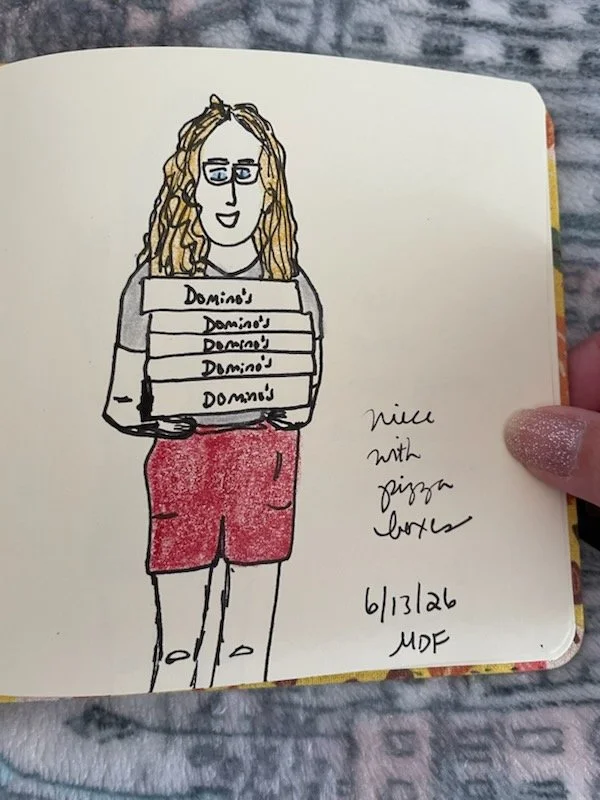
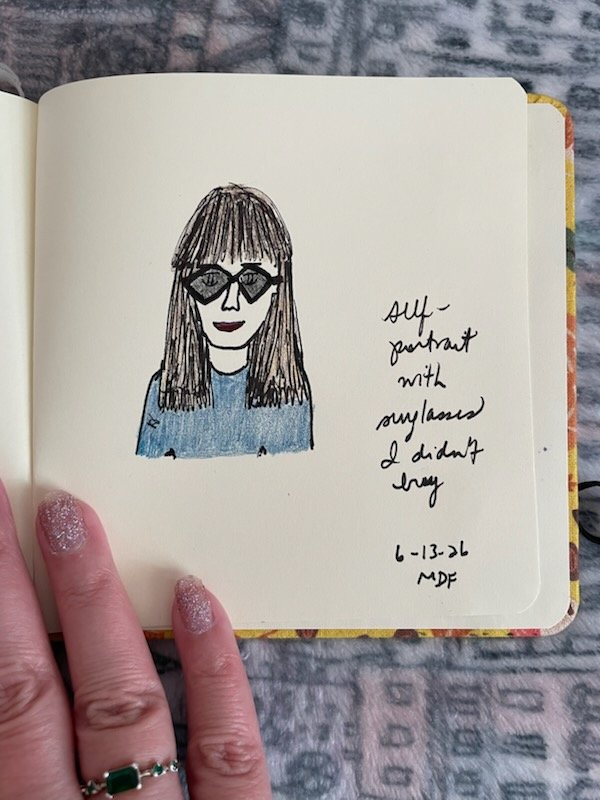
Perseverance or Freedom to Begin Again: I opened up my camera roll recently and chose some recent photos to doodle. I expected very little out of the sketches—mostly, it was for the joy and the practice, and to have a prompt that could help me to leap into making marks on paper quickly, without sitting to think about it for too long. Did the doodles match my photos precisely? Not at all, but precision is not my goal. In the drawing, some fingers were slightly bigger than the others in the peace sign my elder niece flashed to me in the yarn store and my younger niece’s arms under the pizza boxes were too short, and I didn’t quite pencil in the funky sunglass lenses completely on the self-portrait doodle. But does any of it matter? Nope. The hour and a half I sat outside with my little square sketchbook surrounded by art supplies, my hand and mind moving across the page, was the complete goal, and honestly, it was such fun that it felt like about ten minutes. I was surprised to look at my watch and discover it had been well over an hour.

We can put a lot of pressure on ourselves for the first sketches or the first drafts to be beautiful or remarkable, and yet, it’s a great reminder in both arts to invest without expectation of outcome. Also, we  learn when we’d like to continue and when starting over is best. Some drawings surprise me that even if they don’t look objectively great, if I keep finessing them, they can become something remarkable anyway. Or it’s just time to scrap and try again, no penalty. If what I draw starts off wonky and keeps going astray, I can just give a chuckle and turn to the next page. Either way, the experience in knowing when and how to continue or to laugh it off and begin afresh serves well in both drawing and writing (and dare I say? Also in life).

Fulfillment. This one needs little explanation. When I’ve been meaning to write or to draw or photograph for a while but haven’t gotten around to it, I start to feel…deflated, agitated, and distracted.  Once I’ve given myself the gift of a few minutes or an hour making something, I feel more content. I’m just happier when making new things; maybe you are, too.
 

Try this exercise:  Give yourself 20 minutes today that you hadn’t expected and shower yourself with attention, by which I mean: grab a piece of blank paper or a notebook and make some marks, weather that’s a squiggly doodle you shade in, a few sentences about your day so far or your day yesterday, a stanza of a poem, or something else. Need inspo? Give your camera roll a spin and stop on an image that speaks to you. After your 20 minutes do a self-inventory: How do you feel? Are your shoulders more relaxed and less tight? How does your spine feel, and your breathing? Do you feel as if it’s been 20 minutes or a lot less? Repeat this exercise again later in the week and as often as you’d like. 😊


Care to learn more? I’ve got a class for you: Doodling Class clickety-click.
Love to Doodle? Have I Got a Class for You! ✍️

Have you always liked to doodle? Wish you could draw more in a low-key, freeing, self-directed way? Like making marks on the page for the pleasure of it? Now that summer has arrived, I’m super excited to share that I’ll be teaching a super fun online class in August. I’d love to work with you and a friend; mark your calendars. Sign-ups now open. 🥳

Here’s the scoop on my new four-week class, Drawing Doodle Comics for Fun and Enrichment: clickety-click.

Class description: COURSE DESCRIPTION:

Love to doodle or draw but haven’t drawn for a while? Or want to learn a new skill that is rich in narrative and creativity-building skills? Find comics entertaining and interesting? Want to depict memorable small moments from your own life or a character’s life for the joy of recording memories and everyday absurdities that amuse you? Or learn a few techniques that pleasantly blur the lines between drawing and diary? If the answer is yes to any of these questions, welcome aboard!

Nonfiction comics are a delightful blend of story compression, dialogue, drawings, and theme. Comics are an ever-malleable form that can encompass journal entries, a comic strip, experimentation with writing about the self as a character, and so much more.

An Article & A Poem Published!😊

Excited to announce that:

Doodle by yours truly.

·         An article I wrote (about writing more without stressing about it) was published in the WOW March 2026 Markets Newsletter.

·         A poem of mine about a science toy, “Newton’s Cradle,” was accepted and published at a great new venue, Flowers of the Field.

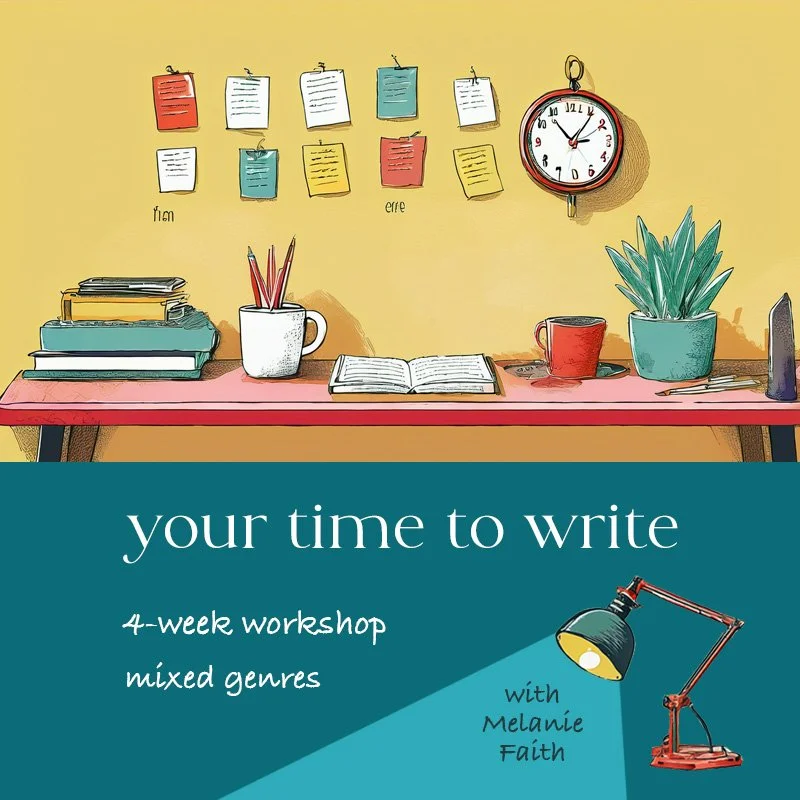
·         Looking for a very fun new online class? Check out: Your Time to Write! Starts Monday, March 16th. Sign-ups open!

To this continued writing life!😊

Courtesy of Women on Writing

It's Your Time to Write in 2026! 😊

Marvelous news! Announcing my new, mixed-genre, 4-week online course Your Time to Write in March 2026! Sign-ups open now.

Invest in your writing afresh in 2026. Writing classes also make great holiday gifts for the authors in your life. 🎁

More info: COURSE DESCRIPTION: Feeling frustrated and wish you had more time to devote to your write? Want some exercises to get yourself rolling creating new pieces? Want to write but feel a little unsure how to (re)start? Working on a long project that’s stalled and want to generate fresh, short, fun creative material to get your muse moving again? Good news: if any of this description sounds like you, you have more time to write than you might think, and investing even minutes a day to your writing adds up well over the course of a month. This class is for you!

To peruse the syllabus and sign up: Your Time to Write Clickety-Click.

Art courtesy of WOW! Women on Writing

"Four Reasons Food Can Spice Any Genres You Write" 🍝

Wonderful news! 🥳My article was published by Women on Writing today! Check it out, and then give the writing prompt a whirl. 📝


Four Reasons Food Can Spice Any Genres You Write

By: Melanie Faith


Photo by Mae Mu on Unsplash.

It’s just about autumn in the US, which is an important weather shift in the seasonal states. Humidity dissolves as leaves turn into a crayon-box bonanza of shades while it remains sunny, bright, and crisp enough for a walk in a cozy, knit sweater and a mug of steamy tea after.  Another signal of the time shift is the shortening of days and the lengthening of my appetite.


While I enjoy eating all year ‘round, there’s something special about the chill in the air and the darkening of the evenings that increases my appreciation for sweet and savory flavors. Bring on the ooey-gooey cakes and breads, the creamy mac and cheese, the hearty, saucy spaghetti Bolognese!


No matter the season, the rituals of eating; snacking; food buying, storage, and preparation; meal clean-up; and food sharing surround our days and can be integrated into our writing to enrich our work.  Let’s look at four reasons why adding food writing to our repertoire can deepen our writing:


Food connects us: Nothing reminds us more of our communities and the cultures we belong to than food.  References to the recipes, meals, and snacks your protagonist grew up eating and still makes can provide shorthand for so many parts of your character’s background and life, including but not limited to her family of origin’s geography, socioeconomic status, and more. Certain foods will instantly be connected in readers’ minds with a particular state, region, cultural heritage, or country, while other foods and beverages are universal to many communities—which will give your readers other insights into how your unique character fits into a larger trend or social sphere or, conversely, how they might rebel against it.  Including meals or restaurant scenes can also demonstrate how your character interacts with others, what she feels comfortable saying or not saying, what she wants to share in public compared to her private thoughts, and so much more.


Speaking of which, food can create both bonds and tensions:  If one of your characters loves attending a weekly potluck she organizes and hosts once a month while another character lives for a quiet dinner for one at home to get away from the stresses of his day job and rejuvenates with the radio on while preparing couscous and a salad, you’ve already set up a way to show (rather than tell) extroversion and introversion. You’ve also set up a scenario where their differing styles could create conflict if these characters become friends, coworkers, family, or romantic partners. Characters can react strongly, or they might have inner hopes or misgivings about what is being served, about their dining companions, or about where the dining takes place. 


Food is also often connected with larger social issues that deeply impact many people both locally and globally—such as food instability, hunger, and ever-rising grocery prices—that you can shine a light on within your writing in nonfiction, poetry, flash, novels, and many other genres.

Photo by Atie Nabat on Unsplash


Favorites and aversions make us each unique. Including small details about what your character loves and loathes eating can strengthen your characterizations. Just like all of us, characters can have detested foods show up in their lives and have to navigate their distaste quietly or verbally, or they can absolutely love quirky regional favorites that their friends and family can’t stand or refuse to try. Conversely, we all love to share our favorites, and sometimes these favorite foods are eagerly adopted by those we love, spreading the joy. Writing that praises, describes, humorously disses, or delights in foods can connect with your audience’s own experiences of likes and dislikes.


Try this exercise!  If you write fiction: your antagonist has just invited your protagonist to dinner. Where will they go? What will they talk about? What is being served for dinner? If you write nonfiction, poetry, or other genres: jot a list of five of your favorite or least favorite foods. Pick one of the foods, set a timer for twenty minutes, and describe a time when you were served or served others this particular food. Use as many sensory details as possible to denote the food and reactions to it. Go!


 Care to learn more? I have a few spots left in my Food Writing class that begins Friday, October 6, and I’d love to have you and a friend join in the fun. Details at: Food Writing for Fun and Profit.