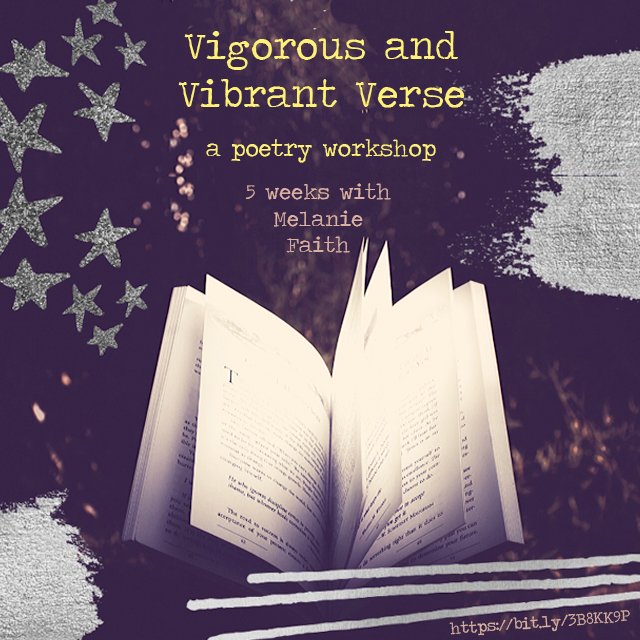
Thrilled that my craft article was published today at Women on Writing! 💗 In the market for an online poetry course that starts in November? Check out my class here. Read on for the article:
3 Techniques to Write More Vibrant Poetry
By: Melanie Faith
Whether we want to write free-verse or a sonnet, a haiku, or a prose poem, some key elements are universal in poetry: vivid imagery and precision of diction choices are two widely agreed-upon qualities of successful poems. The following are three less talked-about techniques that are every bit as vital that could take your verse to an exciting new level.
Everyday is A-Okay: Sometimes, we get the impression poems have to be about monumental subjects or events. Not always so. While there certainly are classic poems to commemorate the big-day events in life, such as high-school graduation or joining the military or marriage or the birth of a child, there are myriad more poems about small observations and tiny moments that, without art, a person could easily move past without reflection.
In fact, the reflections and observations that occur about ordinary topics can, indeed, be extraordinary for readers. I’m reading a collection of poems this week where dates are the titles of each work. In some of the poems, the poet describes people and events of the day literally. In others, the speaker of the poem is obviously someone different than the author or the author combines time periods.
Something authentic and tangible that we observe from our day might spark a poem and then the poem could veer in an imaginative way that surprises and combines fact with fiction—also totally acceptable and, in many casing, inspiring ground for creating poems.
Open your poem with an image grounded in real-life, but stay open to associative leaps that serve the poem, too.
Empty Some Space: Poetry is a compressed art. When I first started to write poetry, as a fiction writer, my tendency was to write long lines (almost margin to margin) crammed with details. I also rarely included stanza breaks.
One day, in graduate school, a favorite professor took one of my poems and, in his critique, marked several places where empty space (sometimes called “white space”) would improve the poem. Mind blown! When I retyped my poem, incorporating the blank spaces, I immediately saw how the focus was stronger on each image and indeed each line and stanza break as well.
Then, I did another round of emptying space: I looked for unnecessary prepositional phrases, words that were vague or place-fillers, and other ways to focus my language even more. The more I refined by taking away from the page as I edited, the more the theme cohered and strengthened.
Both ways of compressing poetry—including more stanzas or new stanza or line breaks to highlight certain key images or words as well as editing out cluttering or vague phrases—can go a long way to bringing resonance to your poems.
Dialogue it up! One literary technique I don’t see often enough in poems is dialogue. While prose frequently incorporates conversations, quotations, or the inner thoughts of characters or speakers, poetry infrequently does.
There are many styles of poetry that even just a line of dialogue could help to set place/setting, time period/era, tone, characterization of the speaker or character, as well as the theme. Narrative and prose poems particularly work well for integrating dialogue, but no need to stop with these formats.
Sonnets could include dialogue or a quoted phrase or inner thoughts of the speaker, for example. Or, a line of spoken or internal thought could become the title of a haiku, tanka, or other style of poem that sets up the body of the poem’s theme or conflict. Or a famous quote could be used as an epigraph to launch into your topic’s theme.
Many types of poems could benefit from dialogue, from lyric poetry and ekphrastic work (such as a line from a song or quote from an online show or another art form) to formal styles, like villanelles (where a repeated question or thought could work wondrously). The sky’s the limit!
Try this prompt: For 3 days, write down three things that happen in your daily life or 3 things you observe about your day, such as an image or an overheard piece of conversation in passing. At the end of the 3 days, pick one of the observations from your list and write a first draft of a poem from this real-life impetus. If the poem veers off of “what actually happened” or if a new image arrives, wonderful and go with it!


